Higher education · enrollment
Higher Education Enrollment: The Atmosphere
Past (≈2000–2022)
Expansion, then a long decline — much of it not yet the demographic cliff.
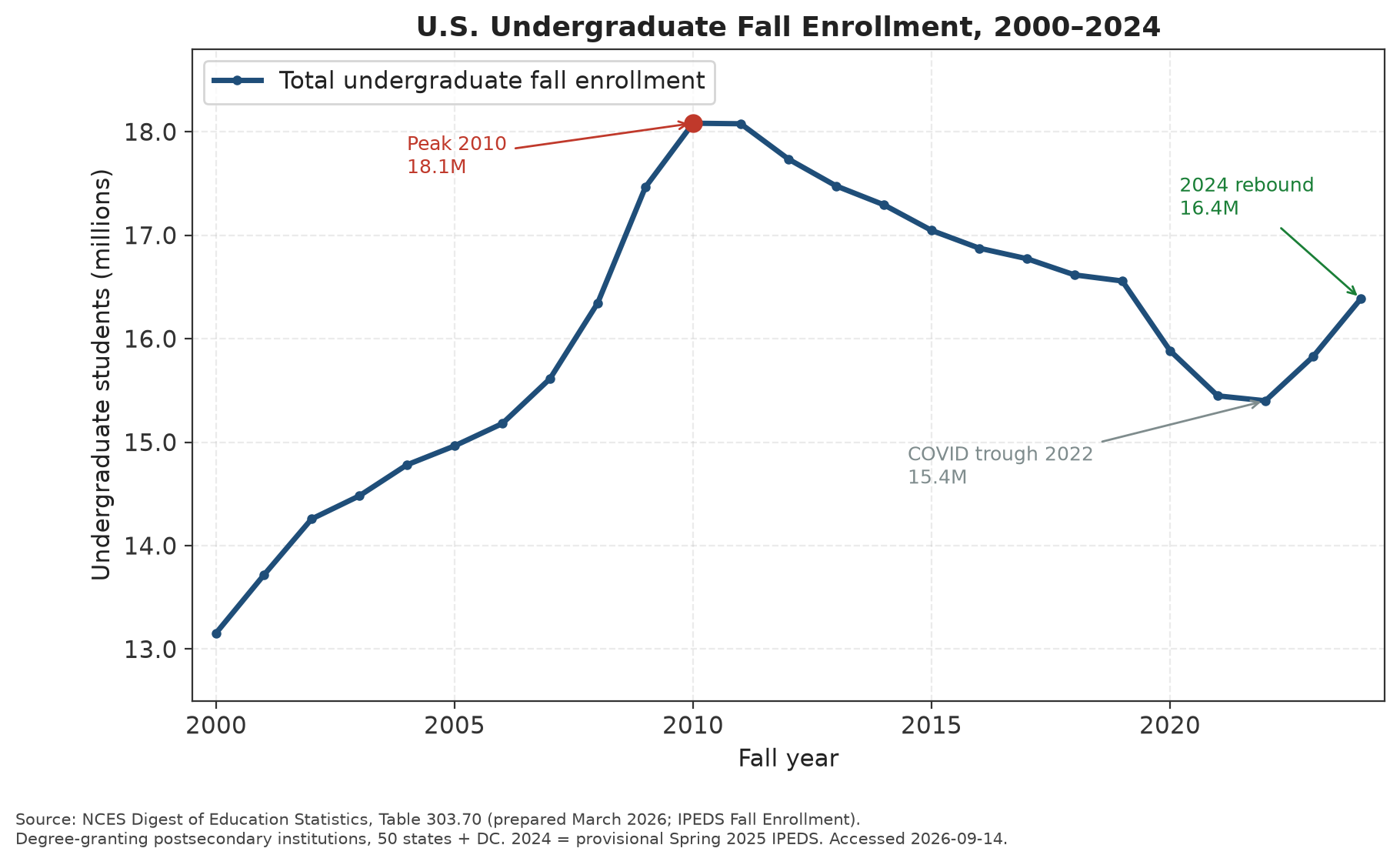
| What happened | Why it mattered |
|---|---|
| Undergrads rose to an all-time peak of ~18.1M in 2010 | Recession-era surge + for-profit growth |
| Then fell for more than a decade to a trough of ~15.4M in 2022 (−15%) | For-profit contraction, community-college losses, weaker participation; COVID accelerated the drop |
| Births peaked in 2007 (~4.32M) then fell ~17% by 2023 | Set up the later “enrollment cliff” for cohorts turning 18 after ~2025 |
Atmosphere then: expansion, then long decline and rising anxiety — much of it not yet the demographic cliff.
Present (≈2023–2026)
Cautious national recovery, active restructuring underneath, and a smaller traditional-age pool ahead.
| Signal | Read |
|---|---|
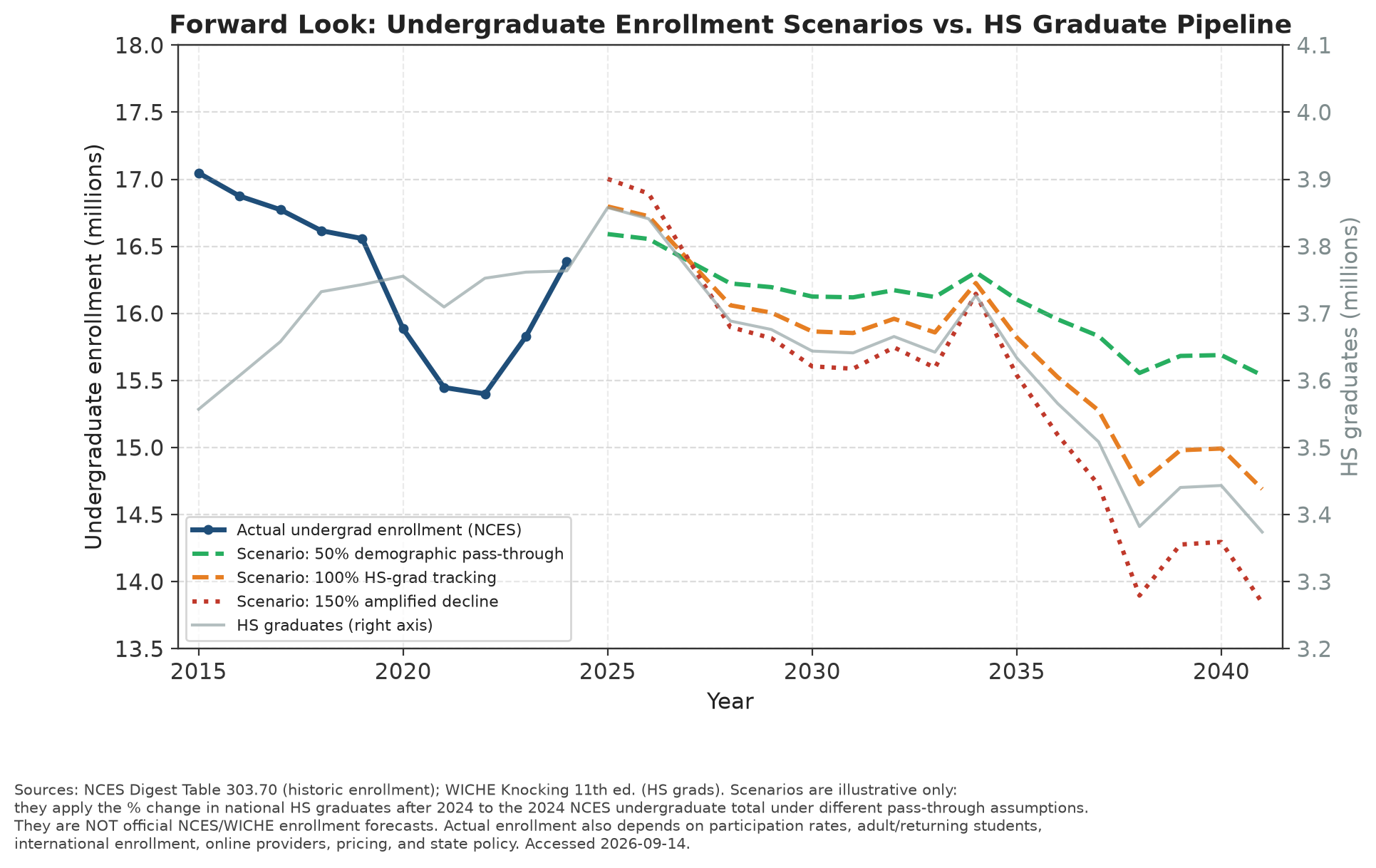
| Undergrads rebounded to ~16.4M in 2024 | Still ~9% below the 2010 peak; demography ≠ year-to-year destiny |
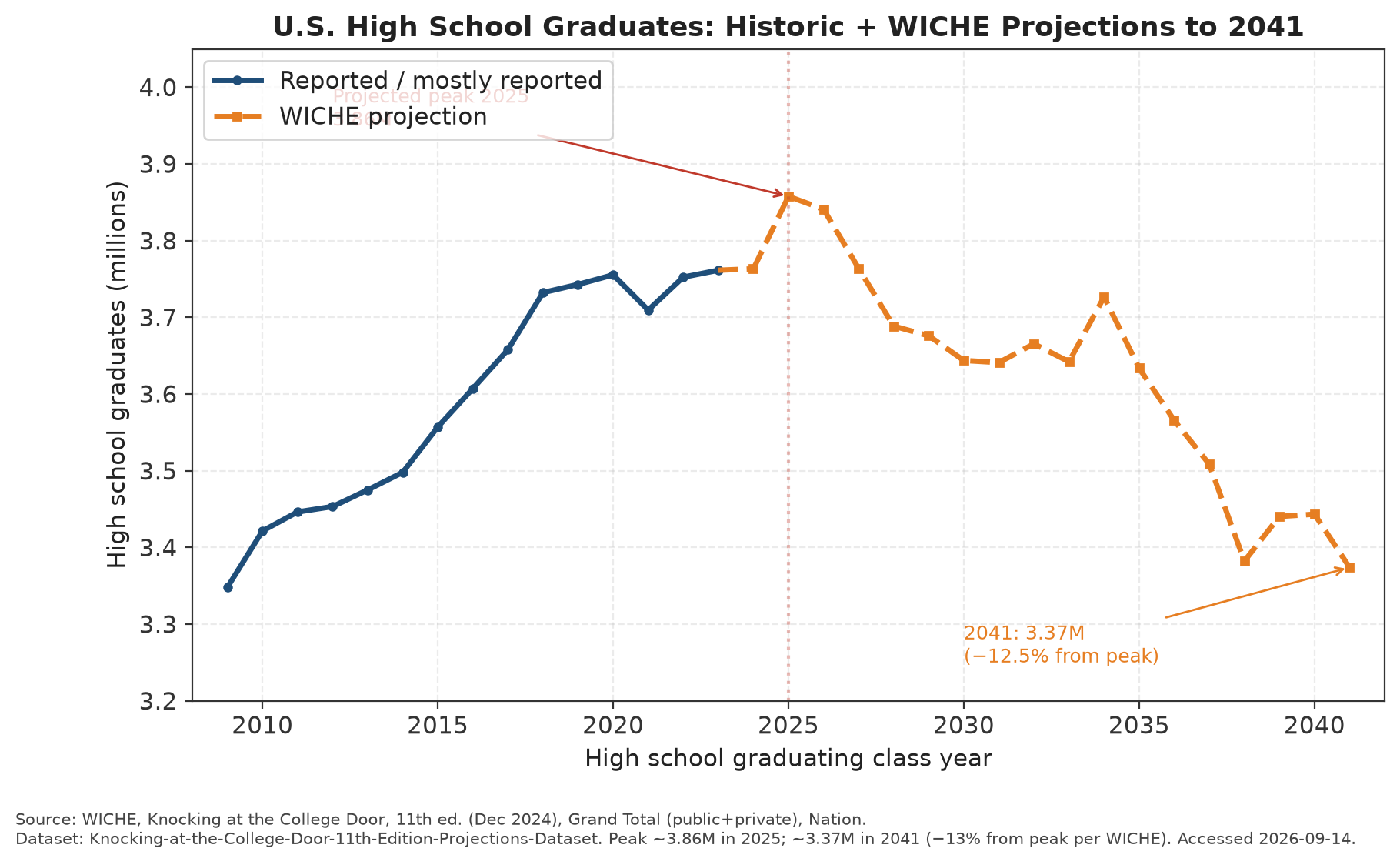
| High school graduates near a national peak (~3.86M, Class of 2025) | Last strong traditional pipeline year before the projected slide |
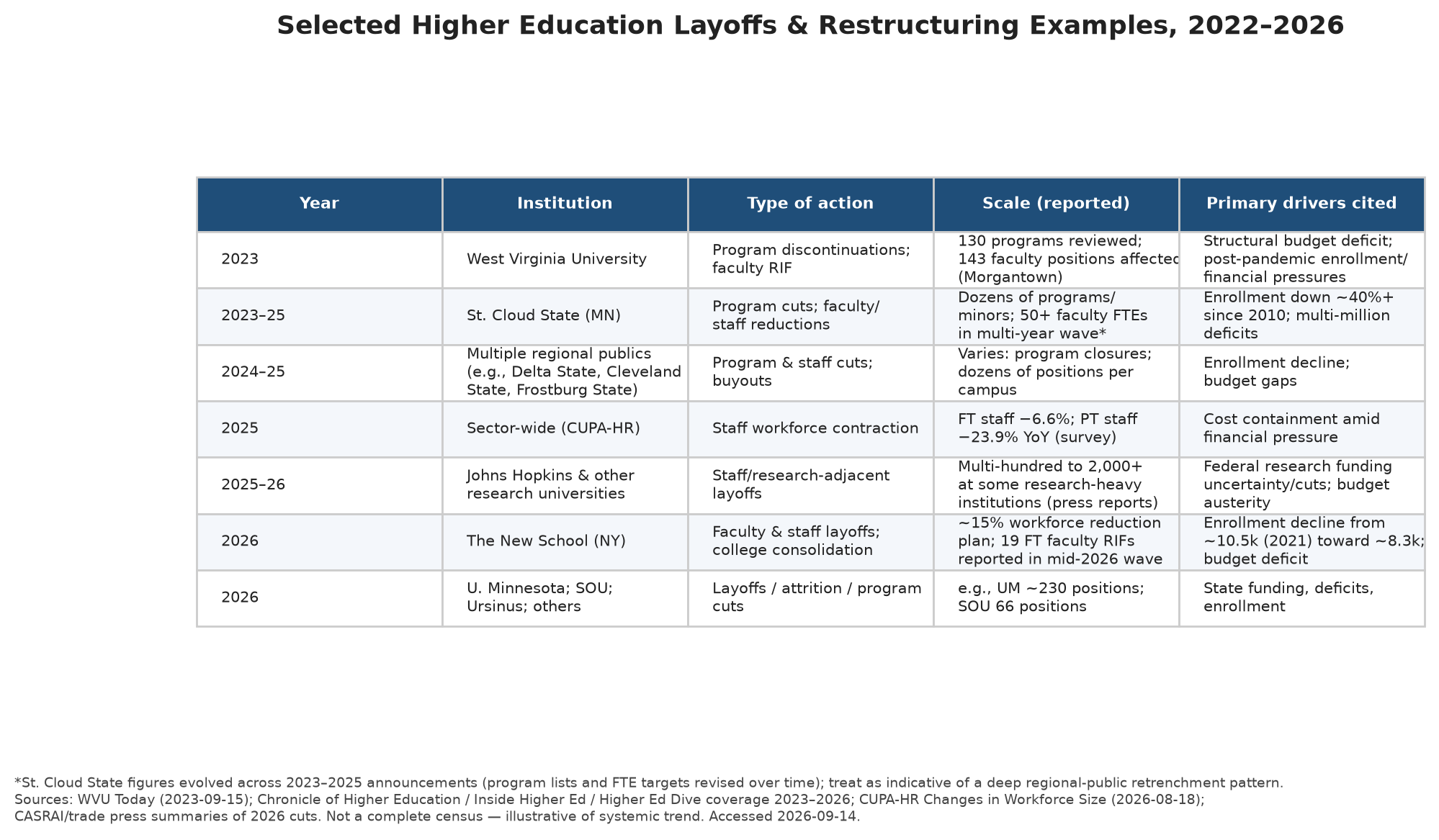
| Layoffs, program cuts, and admin restructuring are widespread | Especially regional publics and tuition-dependent privates; staff often cut harder than faculty |
| Credit outlook turned negative (Moody’s / Fitch) | Costs, aid risk, and federal/policy shocks plus demographics |
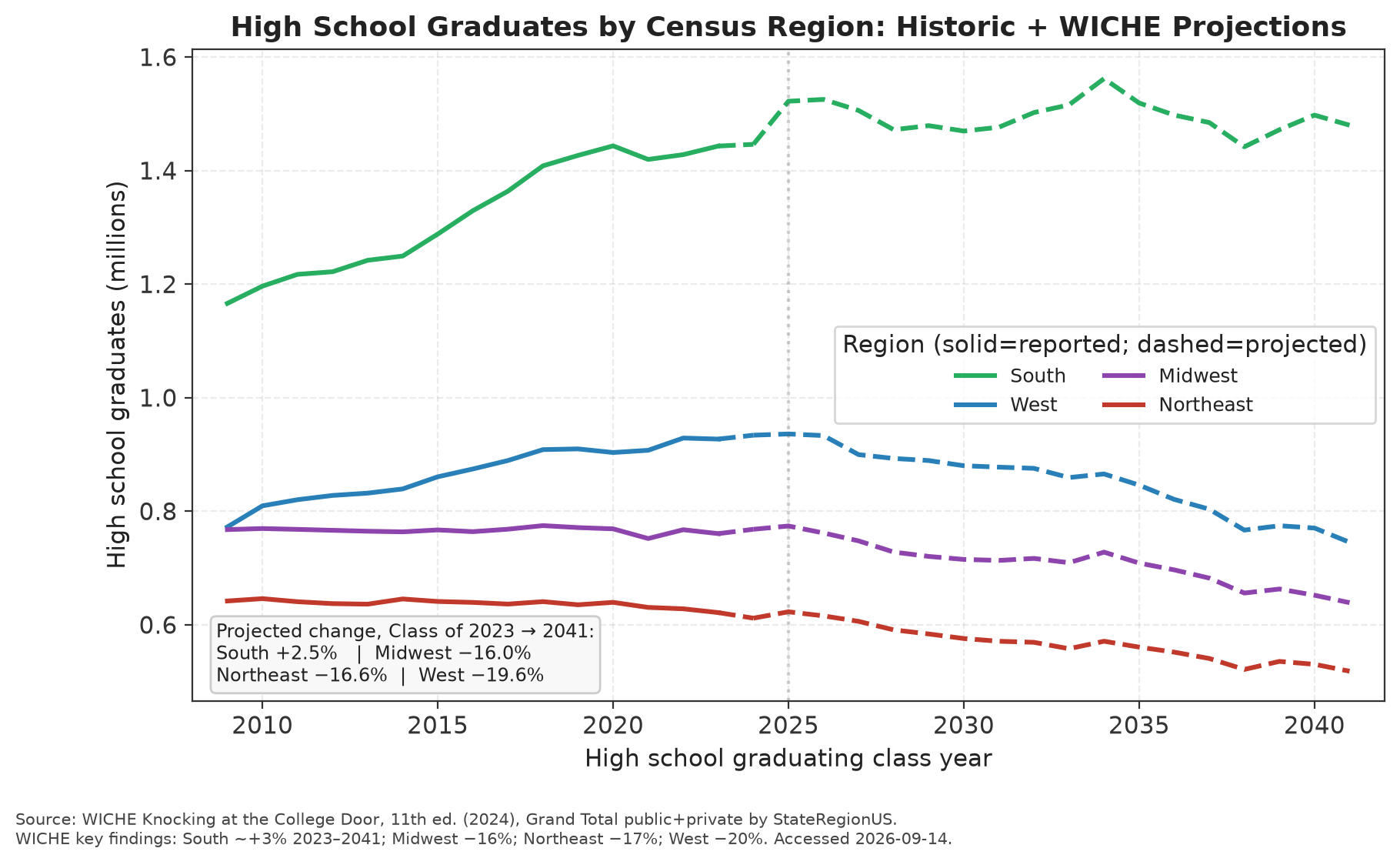
| Geography splits hard | South holds up; Midwest / Northeast / West face steeper HS-grad declines |
Atmosphere now: cautious recovery at the national level, active restructuring underneath, and a sector bracing for a smaller traditional-age pool.
Employment: will higher-ed jobs be hit?
Yes — employment is already being affected, and pressure continues forward. It will not be a uniform wipeout; it will be selective and ongoing.
| Horizon | Employment picture |
|---|---|
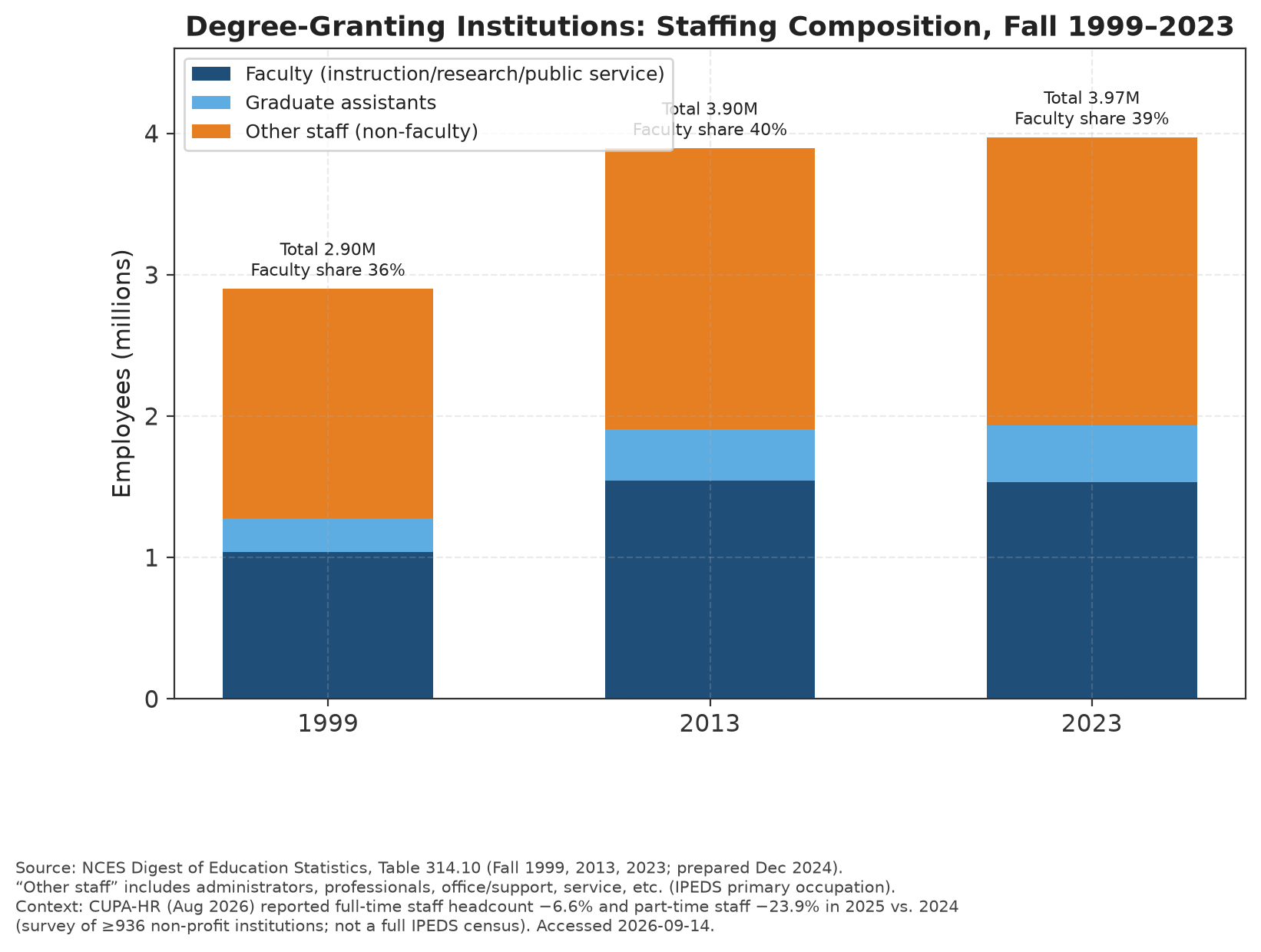
| Already happening (2022–2026) | Program cuts, RIFs, buyouts, hiring freezes; CUPA-HR (2025 survey): full-time staff −6.6%, part-time staff −23.9% YoY — staff bore sharper cuts than faculty in that wave |
| Who is most exposed | Non-faculty staff / admin roles; low-enrollment academic programs; regional publics and tuition-dependent privates; research-adjacent roles when federal funding wobbles |
| Who is more insulated | Strong-brand / selective institutions; growth metros (esp. parts of the South); workforce-aligned and high-demand programs; some clinical/health roles on academic medical campuses |
| Moving forward (late 2020s–2030s) | Expect continued headcount discipline: attrition over backfills, shared services, fewer low-enrollment programs, periodic RIFs at fragile campuses, more mergers — tied to enrollment and costs/policy, not births alone |
Plain answer: Higher-ed employment will keep being impacted. The path looks like repeated restructuring and selective job loss, not a single national employment cliff. Staffing grows slowly or shrinks at stressed institutions even when national enrollment wobbles up for a year or two.
Future (late 2020s–2030s)
A long demographic slope, sharper competition, and continued cost discipline — not a single national collapse.
| Expectation | Nuance |
|---|---|
| U.S. HS grads fall ~13% from 2025 peak to ~3.37M by 2041 (WICHE) | Long slope with plateaus — not a one-year cliff |
| Traditional-age demand softens unevenly | Region, brand, price, adult/online/international mix matter as much as births |
| More mergers, program pruning, shared services, and fringe closures | Bifurcation: strong brands / growth metros vs. fragile campuses |
| Employment stays under pressure | Cost growth + smaller pipelines + credit/policy risk → ongoing workforce redesign |
Atmosphere ahead: managed contraction of the classic 18-year-old funnel, sharper competition, and continued cost discipline — not a single national collapse.
Past reports
Every weekly report stays online.
Latest report (Oct 12, 2026) → · Full archive →
- Oct 12, 2026 — Demography is real, uniform freefall is not: partial rebound nationally, selective restructuring and job cuts underneath.
Get the next brief
Join a free email list for future enrollment and higher-ed atmosphere notes. You’ll get a link to this brief (and the next ones) when they publish — no account required to read the page.
Prefer Substack itself? Subscribe on businessproject.substack.com
This page stays free to read. The list is only for new briefs and occasional updates via Business Project on Substack.
Sources (primary)
- NCES Digest Tables 303.70 (enrollment) and 314.10 (staffing)
- WICHE, Knocking at the College Door, 11th ed. (2024)
- CDC/NCHS natality; CUPA-HR workforce surveys; Moody’s / Fitch sector outlooks (2025–26)
- Institutional and trade reporting on restructuring (2022–2026)